
Resilience and Climatic Alterations
Climate Change and Scenarios
Climate change is a vital challenge involving policy, impact assessment, and a focus on mitigation and adaptation to achieve sustainability. In evolution scenarios, potential CO2 equivalents and Representative Concentration Pathways (RCP) evolution pathways include scenarios with progressively more severe implications, from RCP 4.5 to RCP.
Climate Adaptation
The main strategies for tackling climate change include mitigation, which aims to reduce the impact (of the built environment and others) on the climate—such as lowering greenhouse gases (GHGs)—and adaptation, which involves changing our design practices (across various environmental factors) to cope with a warming world and other climate changes, including extreme events.

Research into climate risks and resilience is expanding
Resilience is viewed from different perspectives (Nunes et al., 2019), ranging from recovery to maintaining the same level, and from persistence to adaptive capacity. Adaptive resilience adopts an evolutionary perspective, which may be more suitable, as emphasised in the socio-ecological system approach, with a variety of applications (Ruiz-Díaz et al, 2020).
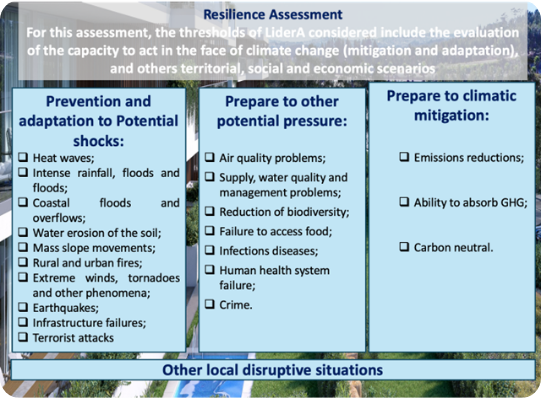
Resilience studies and plans
Using the LiderA V4 model in this programme area, the 4Rs have been developing resilience assessments and solutions to enhance levels of adaptive resilience, with plans and guidance for this endeavour. This also includes the possibility, as has been the case since 2020, of conducting verification and awarding the LiderA resilience certification.