
LiderA Verification and Certification
Certification Processes
The research and market have led to the development of (1) guidelines for sustainable construction, with criteria of varying levels of clarity (some based on life cycle analyses or other environmental impact methodologies), (2) processes for assessing and verifying these criteria, (3) experts to support their creation and evaluation (or auditing), and sometimes even integration into (4) independent certification processes (assessment carried out by third parties).
These practical methods of assessing and acknowledging sustainable construction are becoming more common in various countries, with voluntary market assessment systems being especially prominent among those advocating for sustainable building practices (Silva, 2004).
Environmental Assessment Systems
Generally, the environmental and sustainability assessment system for buildings (or built environments), which then serves as certification, functions as a method for evaluating their environmental performance against a clear set of criteria (Cole, 2003), usually offering three main components:
- The stated environmental and sustainability criteria (prescriptive or performance-based) are well-organised in a logical and attractive structure.
- Assignment of different scoring criteria to each performance on a scale that assigns a particular score when a certain level is reached.
- A form of aggregation, whether by explicit or implicit weighting, used to assign importance to obtain an overall final value, resulting in a total score for the environmental performance of the building or project.
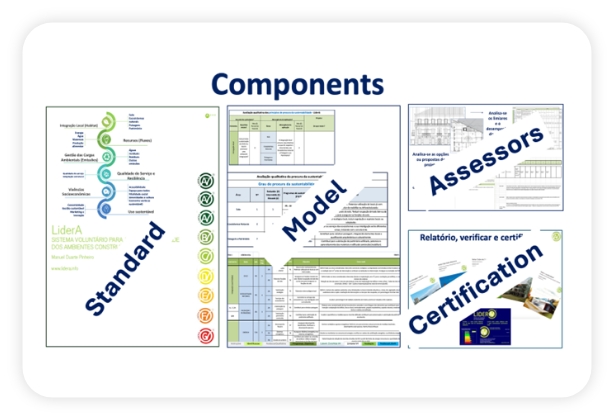
Simultaneously, the systems establish methods to demonstrate, verify, prove, and guarantee performance, and can assign a recognised class. They usually have a registered name (brand), so they are certified by the brand for the level of demand in environmental performance and sustainability.
Voluntary Systems
In this context, integrated sustainable construction support and assessment systems are essential elements for the promotion, design, construction, and management of real estate. They aim to classify, certify, or recognise the environmental and sustainability levels, and are subsequently addressed and detailed. These systems include BREEAM in the United Kingdom, DGNB in Germany, LiderA in Portugal, LEED (Leadership in Energy & Environmental Design of the USGBC) in the United States, NABERS (National Australian Built Environment Rating System) in Australia, BEPAC (Building Environmental Performance Assessment Criteria) in Canada, HQE (Haute Qualité Environnementale des Bâtiments) in France, and CASBEE (Comprehensive Assessment System for Building Environmental Efficiency) in Japan.
LiderA System as a National Reference
In Portugal, the LiderA System (https://lidera.info/en/home) stands out, designed to support the search, evaluation, and certification of building sustainability and built environments, thereby promoting the development of sustainable communities.
LiderA Version 4 has been the current version since 2020, encompassing six categories, twenty areas, and forty programme criteria (with ten optional if not applicable). The Framework, particularly the requirements and main objectives, is detailed in the specific standard. Additionally, value creation has increasingly shown its benefits and potential significance, leading to a rising demand.