
Environmental Sustainability
The United Nations Sustainable Development Goals (SDGs) aim for an integrated approach to development that meets everyone’s needs by promoting fair opportunities and economic growth while reducing their negative impact on the planet. Engineering plays a vital role in achieving the 17 Sustainable Development Goals (SDGs) (UNESCO & ICE, 2021). Humanity has become a significant influence on the functioning of the biosphere. The focus shifts from viewing the environment as an external factor to recognising the biosphere as a fundamental condition for social justice, economic progress, and sustainability (Folke et al., 2016).
Transition to more sustainable models
In this transition towards more sustainable models, the factors of production in an economy shift (Folke et al., 2016) from (A) the traditional classical factors of land, labour, and capital to (B) their expansion into natural capital, human, social, and cultural capital, and human-made capital, emphasising their complementarity.
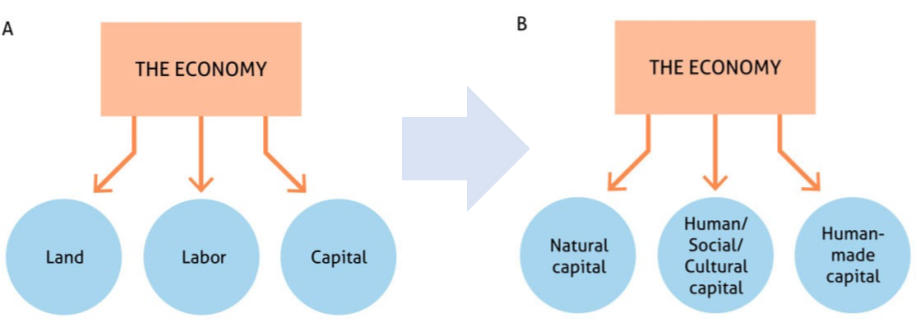
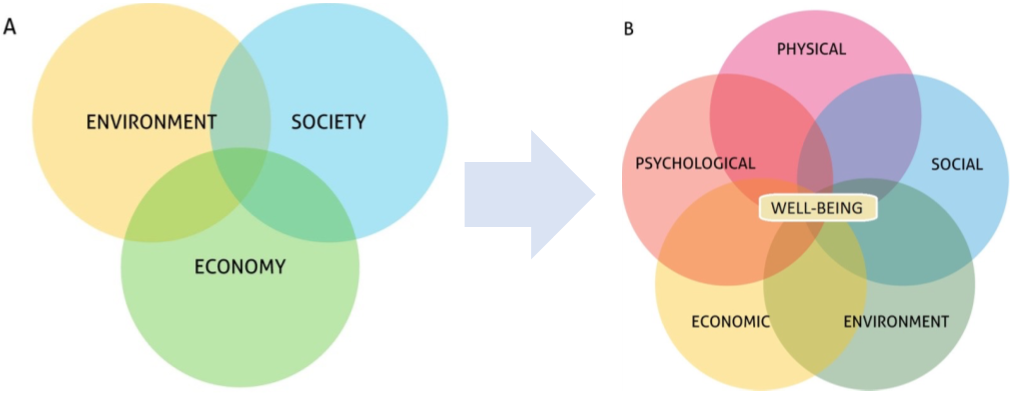
The vision of environment and development is broadened
The conventional perspectives on the environment in development, within this framework, will expand from (A) the three pillars of sustainability—namely economy, society, and environment—as outlined in the report of “Our Common Future” by the World Commission on Environment and Development (WCED) (UN, 1987), and (B) the five factors often associated with human well-being in the development field (Folke et al., 2016).
Ensure essential ecological and environmental processes
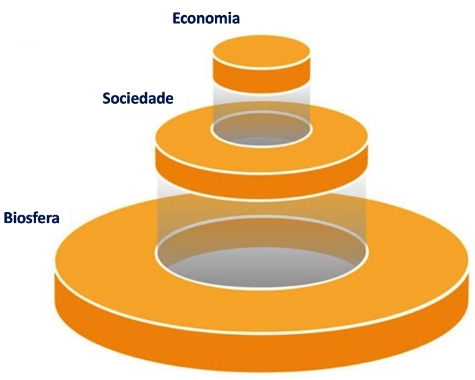
In this logic, the economy and society are embedded within the biosphere as interconnected parts of the planet (A). The biosphere is the foundation upon which prosperity and development ultimately rest (B) (Folke et al., 2016). The 17 Sustainable Development Goals are positioned on the biosphere foundation and the safe operating space for humans on Earth (Folke et al., 2016), assuming the logic of the biosphere base, as its ecological essential processes.
In search of strong sustainability
It is not just important; it is vital to consider environmental integration from the earliest stages of decision-making and the entire lifecycle. While enhancing environmental performance and minimising impacts are essential, the main goal remains ensuring a balance for both people and ecosystems. The societal and human aspects of experiences and satisfaction are not merely important; they form the core of your mission. The emphasis is on understanding these viewpoints and their potential contributions to sustainable development, which is increasingly comprehensive and inclusive, considering not only the integrity of ecosystems but also well-being and economic stability, often referred to as strong sustainability. This approach is reflected in strategic plans (13), circular economy (14), energy transition and decarbonisation (15), resilience and climate change (16), and biodiversity and natural capital (17).