
Circular Economy
Consider life cycle
Economic aspects in environmental assessments are developing to include more information about the entire life cycle, such as life cycle costs and environmental impacts. Additionally, there is an increasing acknowledgement of new economic dimensions like circular and green economies, which are gaining importance as political priorities.
Another variation of life cycle assessments is the life cycle cost, which involves financial investment and operation. It includes forecasts of building performance based on construction, operation, and maintenance costs. This technique relies on the time value of money and expresses life cycle cost as a net present value. In other words, the total cost of building, operating, and maintaining the building is described as a single sum of money needed today to cover these costs over the study period selected for the life cycle costing exercise. The life cycle cost relationship between various building qualities ranges from the conventional type meeting minimum standards to what is currently considered sustainable. Investments in solar (photovoltaic) and wind power generation technologies may eventually result in cumulative lifecycle costs falling below the original construction cost, assuming future energy costs continue to escalate.
Circular economy
The concepts of Circular and Green Economy have gained momentum in policymaking, the market, and academia (Merino-Saum et al., 2020), as shown in the following figures: (1) Penetration of Circular and Green Economy concepts into scientific literature (2000–2018) and (2) Conceptual elements ranked by appearance (number of publications) and relative importance (as a % of the total number of conceptual elements).
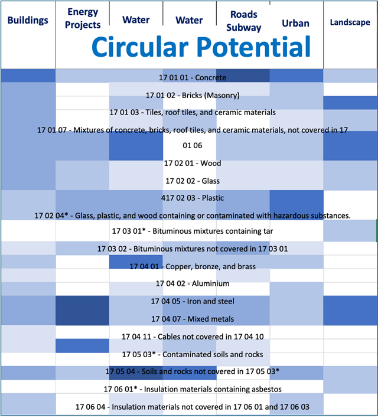
Assess potential level of circularity
The 4Rs offers circularity potential assessment services, including the economic aspect, and suggests options and solutions to develop for adopting circular economy approaches. Among the services, plans for the prevention and management of construction waste or secondary construction resources stand out. The “circular economy,” including (…) waste prevention and recycling, should promote construction projects in accordance with the new general waste management regime and the new legal framework for landfilling, approved by Decree-Law No. 102-D/2020 of December 10, which transposed Directives (EU) 2018/849, 2018/850, 2018/851, and 2018/852 into national legislation. (…) For each of the flows, its potential and solutions can be assessed to maximise value creation.
Construction and Demolition Waste (CDW) Prevention and Management Plan
Therefore, a construction and demolition waste (CDW) prevention and management plan must be prepared, which is a condition for approving the work and whose compliance is demonstrated through inspection. Economic operators responsible for the intervention must ensure that at least 70% (by weight) of the non-hazardous construction and demolition waste (excluding natural materials referred to in category 17 05 04 in the European Waste List by Decision 2000/532/EC) produced will be prepared for reuse, recycling, and recovery of other materials, including backfilling operations using waste to replace other materials, in accordance with the waste hierarchy, using properly licensed waste management operators for this purpose, whenever required by national legislation.
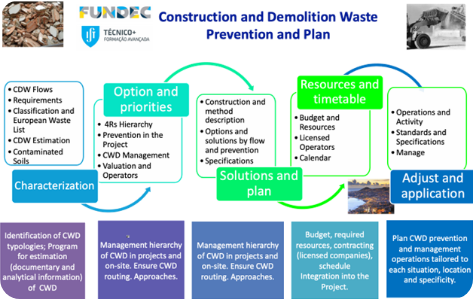
This must comply with the provisions of paragraph 5 of Article 28 of Decree-Law no. 102-D/2020, dated December 10, which states that at least 10% of recycled materials (or materials incorporating recycled materials) must be used in relation to the total quantity of raw materials employed in the work.